Tuesday, 27 January 2015

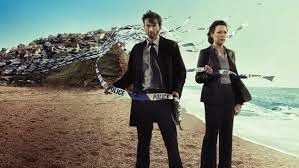
Broadchurch Series 2 Episode 4 Review

So we open this episode finally seeing some emotion from Hardy. Or rather some venerable emotion from Hardy.


This is linked to the Sandbrook murders and the fact that he found the body of one of the girls and possibly nearly drowned recovering her from a river. The fact that he jumped in himself and didn’t have uniformed officers or the fire brigade do it is interesting, but I’ll get to that later.

We also get the long overdue introduction of DI Hardy’s wife and daughter. His wife is an interesting character. She’s either someone who snapped after years of being married to her boss (who seems like the kind of person to bring work place stress home with him) or she’s a partially burnt out copper unwilling to have another run at a failed case. The way that we’re not told about Hardy’s own possible affair, keeps the door open on whether she was retaliating or whether she was just unfaithful. This lines up further options in both their development. Hardy could have taken the blame for her screw up (not out of concern for their daughter) but out of guilt over destroying his own family. Her pathological rejection of him and her assumption that he ran away after the Sandbrook case could be her guilty conscience rationalising her actions not to mention her negligence in handling the case. Either way, half way through the series may not be the best time to introduce her, given the amount of character development involved with those arcs.

In the A-story, the prosecution concludes it’s case against Joe Miller, with Knight momentarily dropping her façade of respectability and throwing boxing metaphors at her junior. This in turn sees the usually confident Bishop privately rattled, but she does at least add more realism to the character. The way she sums up the defences’ job to her junior is particularly good.

“He did it”

“We don’t know that.”

As I said before, defence lawyers (primarily as a result of American shows) are usually portrayed as caricatures; using loopholes and such to let guilty men walk free. Bishop isn’t this, she’s aware that she’s dealing with people and the effect that she can have on their lives. She’s also aware of what will happen if Joe Miller is innocent and he goes to prison.

The other big thing to happen is the reconsideration of suspects for the Sandbrook case. Hardy begins to question himself and there’s grounds for it there. There’s clearly something else going on with Claire and Lee; some sort of agreement between them that she’s not told anyone about.

Overall, this is a pretty watchable episode; it’s mainly set up for the Sandbrook mystery and we get the impression that Knight is going to have some medical problems to deal with while trying to dismantle the defence case.


Supplemental Blog: crazy theory.

So DI Hardy discovered the body of first victim in the Sandbrook murders, but why didn’t he have any back up? Was this during a missing person’s search or did he just find her? What are the odds of a person who finds a body just happening to be a Murder detective?

So here’s the crazy theory: Alec Hardy is a serial killer.

What if he didn’t find that body? What if he nearly drowned while trying to dispose of it? He could have suffered some sort of cardiac problem (possibly the first) while dumping the body of his victim in the river. What is Bishop is right about the inconsistencies in procedure during Joe Miller’s arrest? Why would a Detective Inspector who’s been handling a case with complete professionalism not take the time to a uniformed officer to accompany him and witness the arrest of a suspect? As Bishop said, there is a period directly after the arrest that not even the audience knows about. There is plenty that Hardy could have done to coerce Joe into a confession.

As to Joe’s statement “I’m tired of hiding” perhaps he knew about Hardy; perhaps Hardy has something on him that was keeping him quiet and him saying that he’s tired of hiding is in relation to something that they both did.


Will this turn out to be the truth; probably not; but it’d be damn brave of Chris Chibnall if it did.

Wednesday, 21 January 2015

Broadchurch Series 2 Episode 3 Review.

I’m calling it now, the missing girl in the Sandbrook murders killed her cousin and Lee Ashworth or his wife helped cover it up. And if I’m right about that, it’s going to be even more disappointing than the true identities of River Song and Missy put together.


So “everyone’s got something to hide” is the tag line for this series and as the new dynamic has been set up in episode 1 and the tone set in episode 2, we can now get down to business.

To delve into the legal side (briefly this time) the writers seem to have recruited a legal consultant between scripts as this week they know that witnesses aren’t supposed to be sitting around watching each others testimony. Ellie is forced to deal with the stress of being excluded from the courtroom, as her testimony may be needed. That’s all very well, but what happens when they want to inevitably cross examine Mark, who’s had the opportunity to see watch his wife’s testimony and line up his story with that?

The cliffhanger from last week’s B-story resolves itself pretty quickly. I don’t know about other people, but from my perspective Hardy is rapidly losing the high ground. Miller asked him in episode 1, why he was so sure the Ashworth killed the two girls from his previous case. He didn’t have an answer. We find out in this episode that Ashworth has been investigating the case himself and points out all the things that Hardy overlooked. He’s pretty well written; the way he goes about using official channels to make Hardy apologise to him is good way of quickly developing his character. This also gives an indication of how Hardy may have mistaken him for a killer, if this is the way he conducts himself. This kind of petty behaviour (ie “the policeman is bullying me”) is a character trait that could have caused a personal dislike from Hardy during the Sandbrook case.

Knight’s secrets are coming out, to the audience that is. It seems despite being such a good QC that she can prosecute on a murder trial without being appointed, she doesn’t have enough money to pay her mother’s care home bills. To add to that there’s something in her past that makes her fear tailgaters.

For the purpose of dramatic juxtaposition, Bishop is revealed to have a son in prison. This is the source of the rift between her and Knight. Did Knight throw the case while defending her son? Special props should go to Marianne Jean-Baptiste for this episode. She moves seamlessly from a sympathetic mother to merciless cross-examiner. This is a pretty accurate portrayal of her vocation. Too often in drama, barristers are treated like secondary villains. Bishop is a person; she might seem to be a nasty person when she’s doing her job, but that’s part of her job.


Overall, it’s going well, but I’ll be really pissed off if I’ve guessed the ending to the B-story already.

Wednesday, 14 January 2015

Broadchurch Season 2 Episodes 1&2 Review

So I’m a week behind on this, but whatever.


Broadchurch has returned and is picking up about nine months after Danny Latimer’s killer Joe Miller was caught. As I’m behind, I’m going to be skipping over most of Episode 1, as it was mostly about setting the new dynamic.

Eessentially, Chris Chibnall used episode 1 to shift the A-story of Broadchurch from a murder mystery into a courtroom drama, with Joe Miller disregarding his own confession and changing his plea to not guilty. This leads to the appointment of Sharon Bishop (Marianne Jean-Baptiste) as his defence counsel for a full trial. This in turn leads to the Latimers appointing Jocelyn Knight (Charlotte Rampling) as the prosecutor in the case, as for some unstated reason the Crown Prosecution Service didn’t seem interested in doing their job. I don’t know whether this is a misunderstanding on how a criminal trail works on the part of Chibnall or a deliberate move to keep the family drama aspect of the show alive. The two are immediately great in their parts, but there’s no explanation of how Knight was able to convince the CPS to let her prosecute on a high profile murder case when she apparently hasn’t practiced law for several years.


Anyway, onto episode 2. This is where things start to go down hill a little bit on the legal side. The B story about DI Hardy and DS Miller conducting an unofficial investigation into the Sanbrook murders is good drama, but the legal side falls down a bit.

Essentially, the point that it gets stuck on is that Joe Miller confessed on tape in a police interview. He’s pretty much done. However, in the style of an American drama, Bishop is able to have this confession ruled inadmissible as there’s no guarantee that the injuries he sustained (from his wife) weren’t part of the process used to obtain his confession. Of course, Knight points out that that confession was made before he was assaulted, which is proof that the CPS should have let someone else prosecute in this case. I mean if she was the amazing barrister everyone keeps saying she is, she could have pointed out that an application to exclude evidence should not be made in front of the jury. It might seem like I’m being unfair with that point, but consider how stupid it is for a judge to “order” a jury not to consider something they’ve been told about during the trial. It is impossible for the court to be certain that the jury will not consider a confession as part of their ruling once they have been made aware of it. For this reason, if a confession can be excluded it has to be done I such a way that the jury will never know about it. The jury in this case knows that Joe Miller confessed and the likelihood of a judge solemnly nodding and agreeing with Bishop is very slim, based on her failure to follow the correct procedure. To add to that her failure to attempt to have his confession excluded at a pre-trail hearing could easily endanger her client’s chances of a fair trial. In the case that the judge did agree that the confession was inadmissible, it’s likely that she’d be minded to replace the whole jury, necessitating a whole new trail. I mean I know that Bishop is being built up as some sort of mad skills, maverick uber-lawyer, but I don’t think she’d risk invalidating the whole trail on day one for the sake of a cheap shot at Knight.


Well that’s the heavy bit over, onto the child murder from DI Hardy’s past. The off-the-books and inevitably botched operation to catch the Sanbrook killer provides a good B-story, although I find the conclusion of episode 2 a bit contrived. I mean I get that Beth is a grieving mother, but suggesting that Ellie consciously beat up her child killing husband with the knowledge that it would give him a chance at trial, is a bit stupid. I don’t think anyone actually thinks like that. I’d get her being angry at her on the grounds that Ellie should know better than to beat up suspects, especially given what it’s done to the case against him. But that just shows how unnecessary it is to have Beth react the way she does with the reasoning she has. She has a perfectly good reason to be angry at Ellie; I don’t see why Chibnall feels like she would need to make up another one.

So yeah…I’m enjoying Broadchurch series 2, but I’m acutely aware that shifting to a court room drama comes with risks. The writers have to take care to be accurate. I’m not saying that they should jettison all drama form the sake of characters wearing the correct wigs. I’m saying that the majority of criminal court procedure in the UK is based solidly in common sense. A judge turning to  jury and saying “I order you not to think about X” is just plain stupid.


Friday, 26 December 2014

Doctor Who: Last Christmas

Alien, The Thing and Inception. Being self-aware of where you’re getting your ideas is ok, but I’m not sure about this one.


So, I liked this episode…kind of…I liked the claustrophobic sets, I liked Nick Frost’s Santa and I liked he self-aware references to all the films that were making a more than significant contribution to the story. The problem is that if you’ve seen one of those films, the big twist of the episode isn’t really a twist. In fact, if you’ve seen “Amy’s Choice” then the third act twist won’t be a surprise at all.

But that aside, this is pretty fun to watch, Santa is a pretty good addition and watching Nick Frost run through the logistics of Christmas Eve is quite fun.

Capaldi is on top form as always. He seems to be toning down his Scottish accent and using a Tom Baker voice for some parts, which is an interesting choice.

Coleman is on similar form, though she doesn’t seem to be able to do a old-person voice.

The rest of the cast are all fine, but seem to fade into the background a little bit, one of them being a red-shirt.

But the purpose of the episode becomes more evident as it goes on. This is about resetting things to the way they were before the events of “Death in Heaven”. That’s slightly disappointing, since Moffat crafts a pretty good and suitably emotional way to write Clara out in this very episode. In fact you get the impression that he was among those who didn’t know whether Coleman would sign on for another series.

But anyway, everything’s back to normal aboard the TARDIS and back in place for series 9.


Sunday, 9 November 2014

Doctor Who: Death in Heaven

If zombies were robots!


So we come to the finale; Clara’s in trouble, the Master’s a woman and Cybermen are all over the world, having been made from all the dead bodies.

This episode is very emotional, while still managing to be quite fun. Although we do have the answer to the question: is there a point behind all the repetition in this series?

The answer is no, there is not. We’ve got all the way to the finale and we’re still getting the same get-out-of-jail-free card. Danny can retain his humanity and memories because he loves Clara so much. Which is in no way the same as Rory being able to retain his humanity, when he was turned into a plastic thingy, because he loved Amy so much.

But enough complaining; there’s plenty of good to be looked at. Both Jenna Coleman and Michelle Gomez are on top form (as is Capaldi, but goes without saying at this point). Both these women manage to steal most of the show, with Clara’s attempt to stay alive by pretending to be the Doctor and Missy’s…Missy. As Capaldi is the middle ground between the classic Doctors and modern ones, Missy is a mixture of John Simm’s Master the Master of old. Old fashioned attire, with a penchant for divulging evil plans to anybody listening, with just the right amount of on-show insanity. Gomez puts to rest the question of whether well established characters can still work with their genders changed. A high point for me was when she killed Osgood. Now I quite liked Osgood (especially as she was an in-universe Whovian), but killing her off really solidified Missy as a proper villain. She’s not just going to kill the guards and a redshirt; she’s going to kill well established and liked character.


That said, I can’t pretend I’m not a little bit disappointed in her end goal. She wanted to orchestrate a situation where the Doctor would have conquer the Universe. Her motivation for this can be found (I think) in a line of dialogue from the Simms Master, who described the Doctor as “sanctimonious.” This is essentially the Master picking up that line and running with; trying to prove that the he/she and Doctor really aren’t that different. That’s a pretty clichéd thing got a villain to do, but you barely even notice since it’s so much fun watching Gomez’s dark parody of Mary Poppins.

Now I know that this never could have worked (unless Capaldi was going to be a one-series Doctor) but I would have liked to see Missy’s plan work. I would have liked this to be the birth of the Valyard. It would link up nicely with the classic era. Why was the classic Master so helpful with the Valyard; because it was future version of himself that made the Valyard. Practically that wouldn’t work, but hey, it would have been a very ballsy move by Moffat.

Disappointed not to see what Missy’s TARDIS looked like before she was vaporized (although let’s all just agree that she teleported away at the last minute and not be surprised when she comes back).

The Doctor as President of Earth is an interesting angle, but it seems to be there just to give him nothing to do while Missy and Clara carrying the weight of the show.
Now the Doctor as the person who has to pull the trigger and kill Missy in cold blood. That’s something worth watching. He was willing to do it; not because she was a threat, but to spare Clara getting blood on her hands.

Danny’s ending speech is cheesy, but the timing of this episode is not a coincidence and I think, the idea that a normal soldier could succeed where a member of the most powerful species in the universe couldn’t is a pretty good tribute.

The episode ends on a new dynamic between Clara and the Doctor. When they first met, most of what the Eleventh Doctor said to her was a series of lies designed to keep her around. With the Twelfth Doctor most of what Clara tells him (with regards to her personal life) is a series of lies designed to keep him around. The end of this episode shows that we’ve come to a point where neither tells the other the truth. Clara can’t tell the Doctor that Danny’s well and truly dead and the Doctor can’t tell Clara that Missy was lying about Gallifray.

And there’s a teaser involving Santa Claus….no not getting into that.


Got some holes in the story but a good villain, worth watching.