Saturday, 11 August 2012

Batman Year One Review


To someone who hasn’t read the comics or graphic novels (such as myself) this movie comes across as Batman Begins, The Dark Knight, Sin City and LA Confidential in a sandwich.

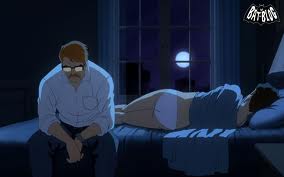
By way of a synopsis, the film opens with the return of Bruce Wayne, to his home city of Gotham, after twelve years in self-imposed exile. At round about the same time, Lt. James Gordon is transferred to Gotham P.D following troubles in his last stationing.  

The majority of the film’s exposition is dealt with through first person internal monologues from the perspectives of Wayne and Gordon. While Gordon’s monologues give far more insight into the character’s motivations and background, Wayne’s come across a bit one dimensional, the resounding message being “I don’t like crime” (which happens to be true of most people). The only significant thing we see about Wayne from the what he tells us, is the suggestion that Batman as a concept is less about imparting his own fear onto others and more about the damage present in his own psyche. There’s even the suggestion that he believes that his father is directing him to become Batman from beyond the grave.

For me, the most interesting thing in this film, was the focus; the primary enemy in this film being Police corruption, with the Mob taking the role of secondary villains. I can’t help but compare this to the Nolan trilogy, where this is more or less reversed.

The further difference shown are in the personalities and abilities of the characters. While Gordon remains incorruptible in terms of your typical bribes and heavy handedness criterion, he’s certainly not the faithful husband and father of the Nolan films. He also happens to be a badass, capable of beating guys twice his size into unconsciousness.  

Batman too is very different, not possessing nearly as much confidence as any of his live action counterparts. At one point he even has trouble taking down three simple crooks, seemingly through sheer inexperience, something I don’t see the Christian Bale version ever falling victim to.
If nothing else, this film is a great comparative piece, allowing us to see perhaps how many liberties Nolan took in his trilogy. Gordon’s partner (Detective Flass) for example; in Batman Begins, he’s a fat incompetent, who moonlights as a Mob enforcer, in this he’s a former Green Beret, who seemingly makes enough money through taking bribes and enforcing the private interests of more senior (and equally corrupt police officers).

Eliza Dushku is pretty awesome as Selena Kyle and her back-story of – spoiler warning  - being a prostitute and possibly having a lesbian relationship with her friend Holly is somehow more believable than the Anne Hatheway version in "Rises" and definitely the Michelle Pfeiffer version in "Returns."

There are a couple more differences that really shine through, but overall it follows roughly the same ground as the Batman Begins.

This might not be for everyone; some may question why it even needed to be made, in light of the live action films, but this film really gets to grips more with the characters. It also manages to bring the grit of Gotham to life at least as much as the Nolan films, which is saying something.

It’s good, but if you haven’t read the comics or novels, you’ll find yourself retreading bits of old ground and kind of wishing Morgan Freeman was there

Wednesday, 8 August 2012

Artemis Fowl: the Last Guardian Review


Well here we are at the end of the Artemis Fowl series. It goes out on a high, but certainly isn’t the best that Colfer’s produced.

The Artemis Fowl series started with an 11-year-old boy, who seemingly used nothing but pure logic and intellect to make decisions, with no concept of ethics or morality.

The core of the series has always been the personal development of Artemis himself, which started at the end of the first book.

The changes that have occurred to the central protagonist’s personality are fully manifested in this book, with Artemis’s intelligent conclusions coming second place to his more emotional concerns. He also experiences some loss of confidence in the face of being outfoxed.

One great contrast that Eoin Colfer throws in is between Artemis and his brother, who is, like Artemis in intellect, but has a twin, who he loves and could not survive without. We get the impression that Artemis could have saved himself a lot of repressed emotions, had he had something similar and not grown up alone and with little to no emotional input. To this effect, he grew into the near emotionless boy that kidnapped Holly Short in the first book.  

Right…now the bad bits.

Mulch Diggums is always welcome in any story, but the way he gets involved in this one is a bit contrived. He pops up out of nowhere and has an excuse for it that kind of undermines most of the character development he’s had in all the preceding novels.

The characters don't really develop much and some do take a couple of steps backwards for the sake of the plot's convenience. 

The intelligence gap between Artemis’s two brothers seems weird and a bit unbelievable. I still don’t get how Opal Koboi manages to escape, as the method does seem to rely on completely undermining the time travel rules established The Time Paradox, with an excuse that wouldn’t be out of place in an episode of Enterprise.

Moving on, at this point, the level to which Artemis is physically useless goes too far and the idea that he’s that intelligent, yet hasn't figured out a way to not be so dyspraxic loses almost all believability.

Overall, this isn’t bad, Artemis Fowl goes out on a high, but the ending is a bit clichéd. In my mind this book is at 7 on the quality list. It’s better than The Atlantis Complex, but the others clearly outstrip it.

Wednesday, 1 August 2012

Dark Knight Rises Review


Good, but not nearly as good as the other two. I found this film pretty awesome, but some major issues stuck out for me.

So this is a weird one to react to. The film was good; good story well put together, well acted, but there was something lacking.

After much time spent thinking in my procrastination cave, I’ve come to the conclusion that this film essentially lacked the underlining message of it’s predecessors. Now I’m not saying that the fist two Nolan films had the same message, but that they both had a message that manifested by the end of them. Batman Begins was about how Bruce Wayne had to learn that it wasn’t who he thought he was on the inside that mattered, but what he did about it that was his defining feature. The Dark Knight was about, seeing oneself become a villain or symbol thereof and by extension the dangers of power.

In this film, we get kind of half a message of not giving up in the face of a set back or initial failure, but that runs thin so quickly that by half way through the film, Batman has to be re-crippled so that he can seemingly learn the whole lesson all over again. This comes at the expense of the second act of the film, which, in itself, is the reason that this one drops below the other two on the quality scale. Too much time is spent retreading old steps and literally learning the lessons that have been learnt four seconds ago.

Another thing that really bugs me is Catwoman. Anne Hatheway does a sterling job in the role, but the problems come in the love interest element to the character. Namely that she’s more of a friend/begrudging enemy of Batman, up until the end where she suddenly decides she’s a love interest. Given the pretty significant reveal about the other main female of the film, it’s clear why she had to step up to the plate, but the rate that she goes from using Batman for safety and snogging him seemed a bit contrived, as though it’s been tagged on to the script very late on.

Christian Bale continues to deliver as both Batman and Bruce Wayne, bringing new elements to both. For example, he frequently dials back the Bat-voice while in costume, to be more recognisable to those who already know his secret identity, which, incidentally, seems to be almost everyone, and shows a far more damaged version of Wayne to the world.

YAWN….tired now, this is a good film, but the second act lets it down royally, but other than that, it does a fine job of completing the Nolan trilogy. Performances all round are good. Actions good and gadgets are AWESOME!

Friday, 15 June 2012

Underworld Awakening


So this film is shockingly clever….well in terms of plot, it isn’t, or narrative or characters. But the main thing that’s so clever about it is that it was marketed as the franchise of the previous two films shamelessly ripping off concepts from films like Resident Evil and Alien.
So I was expecting to watch this with an air of disappointment, as I witnessed the tarnishing of the two previous films (which I quite enjoyed) by endless clichés and bad guys who all end up turning into the same friggin’ monster.

To spoil it slightly, most of the trailers for this film are loaded with red herrings, which is a most welcome aspect of the promotion of any film. This means that the more important twists and turns actually come with some surprise attached to them.

But anyway; the Plot. After Vampires and Werewolves are exposed to the world, the human race begins a fear driven extermination of both species, under the direction of Dr. Jacob Lane. This doctor captures series protagonist Selene and cyro-freezes for twelve years, until she’s released, by a scary-looking little girl with the same accent as her.
Kidnapped by Evil Corporation or waking up from an awesome night out?

Now this is all pretty standard stuff – the years in cryo-freeze is how Aliens and Alien III begin, the concept of a small English girl milling about in a uber-corporation’s facility in America is straight out of Resident Evil. What shies this film away from rip-off territory is the actual progression it makes, with the central characters.

Selene for example, maintains her ability to walk in sunlight (gained in Underworld; Evolution), where the Resident Evil, writers had to contrive the character of Alice back into a normal human being in the latest in their vessels in order to get any drama out of her. However, it does seem that her captors were unaware of these extra abilities, so it does beg the question of why they just kept her frozen for twelve years rather than exterminating her with the rest of the Vampires.
Personally, I just imagine two guys in tact suits about to finish her off when one says to the other “wait a minute, isn’t she the central protagonist?”

That and another couple of logical flaws aside, the film is quite fun to watch. Kate Bekinsale manages to avoid the trap of making Selene into a man with breasts (as has been done with many heroines in film) by bringing some emotion to the character. The little girl is very creepy, as only a small quiet English child can be, but also brings a lot to he table in terms of vulnerability and…err…other little girl things.
Some of Selene’s allies are a bit contrived as far as motivation and with the exception of one character we don’t really see much of the humans or their reaction to the two other species, other than the first few minutes of the film.

In a closing note, the Underworld films get a lot of flak for Kate Bekinsale’s outfit, which, with my expertise in fashion I have identified as a skin-tight, rubber thing. Some people will write off this film, based purely on the way they’ve dressed the central character to appeal to one gender alone and while I fail to see the tactical advantage in a combat soldier wearing a modified wet-suit the whole time, I wouldn’t say it’s a valid reason to discredit the whole story of a film.
So where do those Guns go when you're not holding them?

Overall, not a bad film, which is a pretty good achievement for the fourth in a franchise.

Tuesday, 27 December 2011

Doctor Who Christmas Special Review.


It was ok…but that’s kind of a bad thing…

So after what I thought was a good but underwhelming series finale we had this. It was alright  - but there was something missing. Throughout everything he writes, Steven Moffat has always gone against the grain, constantly attacking common conventions in whatever genre he’s penning for, but always in a bantering, playful way.

But this episode has little of that  - it’s got the doctor somehow getting dressed into a space suit while falling through the atmosphere yeah, but that’s about all.
Great amounts of this episode were spent with me waiting for Doctor Who to show up. Not the Doctor himself but the feeling of Doctor Who (anybody who’s listened to the podcast for “Forest of the Dead” will know who I stole that turn of phrase from).

This episode, while being a good story could have been in any show  - and considering that it came from the same man who made “A Christmas Carole” (a self-aware take on the classic tale, which somehow managed to have moving love story and a brilliantly silly premise co-exist) it just seems disappointing that this take on the Narnia formula gets so tied up in the very Avatarish feel that gets thrown around.
Even at that, it’s too much about the family at the centre of the story  - last year worked because it was all about saving a large amount of people by resolving the issues of the characters. In essence there was always a goal  - this episode was just about the Doctor doing something nice for someone who’s been nice to him. All very well, but if I don’t happen to be able to empathize with those characters then there’s no real threat for the audience to get involved with.

That’s the problem with for me; I didn’t really find Madge Arwell particularly interesting. Its nothing to do with the way Claire Skinner plays, it’s just that there’s nothing new about the character.
Bill Bailey provides the comic relief for this episode and it’s without doubt the best bit. But it does fall a bit flat and the bit with the subordinate crying along with Madge really didn’t agree with me and fell a bit flat.

The whole episode in general seems a bit underdeveloped and everything seems far too simplistic and shallow. There’s only so much that can be done with trees after all. Oh and if they grew everything themselves where did they get that metal crown?

The twist of the forest wanting a “mother” ship is a much desired and lonely piece of Moffat writing.

This was an alright episode, but not something I’d expect from Steven Moffat.

Sunday, 20 November 2011

Twilight Book Review


So, for those of you who don’t live near me, or listen when I talk (which is most of you), I recently read Twilight…and yes, I have now been forced to accept that that does make me less of a man.

I like the fact that the central character, Bella, goes to a small school and is instantly popular. As someone who went to a small school, I understand that if someone from a far larger school transfers in, the common procedure is to regard them as something fascinating and lob them in with the cool kids. 

I like this, because Stephenie Meyer could have easily got away with making Bella an outcast and giving her some empathy with the character of Edward. However, rather than taking that distinctly conventional approach, Meyer opted for the more realistic one. Good move Meyer – my compliments – yes readers, it was very painful for me to say that.

Right, onto the things I don’t like and (surprise surprise), they outweigh the things I did like. Firstly, Bella…what the fuck is with this girl? Everything is seen form her perspective – a perspective, which could make Barack Obama look like Satan. This girl is not only negative about everything, she’s an ARSEHOLE. She moves to Forks and it’s shit, she goes to her dad’s house and it’s shit, she goes to school (and is instantly popular) and it’s shit. Not only does she come across as miserable, but also unappreciative, arrogant and bitchy. I read the first chapter, and literally, the only thing that kept me reading past that was the prospect that Bella might get killed later.

Secondly, I have to make issue of Meyer’s writing technique and one major flaw in it that I just couldn’t get past. To give you an example of this, I can refer to the description of Bella’s mother given from Bella’s perspective, in the first chapter: “my mom looks like me, but with short hair and laugh lines”. That seems fine, until you observe that we don’t get a description of Bella herself, until two pages later. When I raised this complaint verbally, a nearby Twilight fan pointed out that Meyer was simply developing the character later…my response to that, is no she fucking wasn’t…that may have been the excuse she used or she may have honestly believed that…To illustrate the point I’m trying to make here, 

I’m going to use the example of Doctor Who (I'm sure you're shocked about this). In point, I would like to refer to an episode the first of the revived series in 2005. In the episode called the “Empty Child” the Doctor is told by the character Dr. Constance, that before World War Two he was “both a father and a grandfather and now [he is] neither” the Doctor replies “I know the feeling” implying that he is in the same situation and that he himself had children and grand-children all of which are now dead. This point is again referred to in series two (I can’t remember which episode) when the Doctor makes a remark in passing that he was once a father. We then have to wait till series four, before this is elaborated on in the episode “The Doctor’s Daughter.” How does this relate to my complaint about Twilight? Well it’s very simple, our having to wait that long is the result of the Doctor taking four years to properly come to terms with the fact that his children are dead – although we are told that he had children, his character requires four years of development to give us any more information about that fact. This is the concept of development within a long narrative. This cannot be applied in the way that aforementioned Twilight fan attempted, because she was attempting to apply it, not to a developmental part of the character, but to a PHYSICAL DESCRIPTION!!!!! This doesn’t work, if you’re going to describe what someone looks like, in two separate parts, you don’t start with the last part, then mention the first part later, that doesn’t develop it, that just renders the description completely useless…she might as well of put a footnote in saying “see two pages ahead for full description.”

Thirdly, you might have noticed that I haven't written a brief synopsis of the plot to draw on. The reason for this is that, past the first three chapters, there really isn’t much of a plot to speak of. In fact past the third chapter, the story seems primarily based on repetition of the same thing. Now, I don’t wan to boast, but I have written a draft of what you might call a novel and while I accept my limited experience, next to published writers, I can say that I did get to know how hard it is to write a novel-standard amount of pages, without repeating yourself. This means that I can see what I regard as the primary reason that there is so much repetition in this book and I can empathize, to a degree, with Meyer concerning it. However, even factoring my empathy in, I can’t forgive her for it. I haven’t been taught this, but when I was writing and found myself in a situation where I had to repeat a piece of information, I always tried to paraphrase it, add a new factor to it or even use the fact that it was being repeated as a point of frustration or amusement for the character who was having to repeating it.

Meyer barely even attempts this; Bella and Edward literally have the same conversation about eight times, which goes something like this: Bella: “I’m in love with you” Edward: “but I’m dangerous”.
This same argument between them only disappears in the last chapter and the epilogue. Unfortunately, Meyer chooses this point to raise the argument that will probably dominate the next book: Bella: “I want you to turn me into a vampire” Edward: “but I don’t want to turn you into a vampire”…This is the foundation for a series of books…repetitious arguments that aren’t even altered or rephrased…

I have now reached my fourth and final major complaint…James…I liked this character (why then does he not appear in the good-point section of the review?). it’s quite simple really…Meyer fucked this character up. I loved the idea of a classic vampire who was obsessed with hunting young women. This is how Count Dracula does things and while some could call it conventional, I find it slightly refreshing to actually have a vampire whose threatening, unlike all the Cullens, who are, quite frankly, too nice to be vampires. I have to say that I loved the character of James, right up until he spoke and came into conflict. It seems Meyer is massive fan of Super Hero movies, because, as soon as James has Bella where he wants her, he starts MONOLOGING!!!!! Your aim was to kill her, so kill her…with the exception of some really quite unimportant information about a member of the Cullen family, we already know everything James says to Bella, so what’s the use of him saying it…

Let’s sum up:
I hate Bella, because she’s really a bitch
I hate Edward, because he’s repetitious dumb-shit
I hate the Cullens because their niceness renders them not vampires at all, Meyer makes them almost faultless which strips away anything interesting that could have been done with the characters.
And I hate James, because, after being an interesting character, he starts acting like Lex Luthor.
And I hate the other two vampires who make an appearance, because they really serve no real purpose…


Monday, 7 November 2011

Stuff that Annoys Me

So it’s essay time yet again, which means you get to find out what I think about any given thing that pops into my head, when Doctor Who’s not on.


People who say ‘a joke isn’t funny if you have to explain it’

I should qualify this one; there are jokes that are simply too complicated to be funny, but more often than not the person who utters this infuriating phrase, after you’ve lined out the punch-line, was the only person in the room who didn’t get it. My response to this is always to say “I didn’t have to explain it, I only had to explain it to you.” It is infuriating when you’re trying to tell a joke or exchange banter in a social situation and people blame their own slowness on you.

Why was Kylie Minogue in Doctor Who one time?

Yeah another one about Doctor Who – sue me. Why did the production team of Doctor Who feel like they needed to pull in an Australian pop singer to do the job of an actress. Yeah, I know she was an actress before being a singer, but there were far better people out there who could have played the part of Astrid Perth. The most recent Christmas Special (“A Christmas Carol”) saw the casting of Katherine Jenkins and rather than it just being to get her fans involved with the show, he specific talents as a singer were made integral to the plot and resolution of the episode.

Do the writers of Sarah Jane Adventures think the audience is retarded?

Yeah, I know this series is written for kids, but even kids don’t need to be spoon-fed some things. For example a really annoying thing happens in the crossover episode “The Death of The Doctor” while the Doctor is using some sort of awesome, shiny machine to do a sort of teleport body swap with Clyde. This is actually done quite well to start with, with Clyde being the only one aware of anything different, until everyone else notices that on of his hands has changed into one of the Doctor’s. He then says the line “That’s not my hand, because my hand’s not white.” I don’t get why the writers felt the need to remind the audience that Clyde’s black. The fact that he was sporting a hand that wasn’t his was obvious; it didn’t need to be explained any further than the first part of the line.

The Existence of Twilight

Do I even need to explain this? Ok, given my rants about people who write to the BBC to complain about what they perceived hour of filth and violence they had sit through watching Torchwood and how these people should just invest in an off button for their television set, it might seem quite hypocritical to hate the existence of something that I am under no obligation to read/watch/ever interact with. But my problem is not with the books themselves, but more what they symbolise in our modern world.

It centers around the single element of being astonished about the fact that the books of the Twilight Sage can be classified as novels. A set of books filled with spelling mistakes and some of the poorest grammar I’ve ever seen, based on the most superficial elements of the most lazily written “love story” in literary history. While trying to think of a good way to summerise what’s wrong with the love story in these books, I ended up stumbling across the perfect way to describe it, while watching a youtube review of the Star Was prequels. In that, long time sci-fi commentator, RedLetterMedia, said of the love story in those films, something along the lines of “look two attractive people in a beautiful location, that means they’re in love kids.”

The fact that such lazy writing can earn a person so much money pisses me off to no end. J K Rowling made a lot of money, by writing a series of books about morality and good and evil, in the guise of a story of a boy wizard. Stephenie Mayer wrote a template for the perfect domestic abuse victim and topped it off, by making all the supporting characters so fucking superficial and forgettable.

And while we’re on Twilight as a subject, can someone explain to me just what Alice’s power is? She can see the future of any given person so long as said person doesn’t change their mind. Um…anyone can do that; that’s not a special power.